
Hi, I’m Dalia Xu, a 30-year-old seasoned travel enthusiast with over a decade of travel experience. I have a passion for natural landscapes and hotel reviews. Xi’an’s metro system, a modern transit network winding through the ancient capital’s millennia-old history and dynamic urban development, is more than just a way to get around—it’s your key to unlocking the city’s blend of imperial heritage, natural beauty, and contemporary charm with effortless ease.
With multiple metro lines spanning the city’s core historical districts, sprawling modern neighborhoods, and key transportation hubs, Xi’an’s subway connects iconic sites like the Terracotta Army (via transfers), the Ancient City Wall, and serene natural spots such as the Qinling Mountains’ outskirts. Whether you’re here to marvel at ancient relics, wander through lush urban parks, or discover boutique hotels nestled in historic lanes, the metro will guide you seamlessly. In this guide, I’ll walk you through the Xi’an Metro Map, highlight must-visit stations tied to natural landscapes and top hotels, and share tips to make your metro journey in Xi’an a memorable part of your travel adventure
Xi‘an Metro Overview – Why It‘s Your Best Friend in the City
Let me be completely honest with you — when I first arrived in Xi‘an, I was absolutely in awe of the ancient city walls and the Terracotta Warriors, but I was completely intimidated by the metro system. The maps looked like a colorful maze, the station names were a mouthful, and I had no idea which line would take me where. But after four years of riding this system almost every single day, I can tell you this without any hesitation: the Xi‘an Metro is one of the most modern, cleanest, and traveler-friendly subway networks I have ever used anywhere in the world. And trust me, I‘ve used a lot of them.
As of 2026, the Xi‘an Metro operates 12 metro lines (Lines 1, 2, 3, 4, 5, 6, 8, 9, 10, 14, 15, and 16), with a total length of about 441.67 kilometers. The system has 246 stations with 37 transfer stations. And here‘s the exciting part — the network is still growing. The brand new Line 5 East Extension opened on June 30, 2026, adding 3.21 kilometers and two new stations (Yanming Lake and Xi‘an East Railway Station), finally connecting the city‘s eastern rail hub to the metro network. This city is literally building its metro network at lightning speed — Xi‘an was the 14th city in mainland China to open a metro system when Line 2 launched in 2011, and now it‘s one of the most extensive networks in the country.
What I love most about the Xi‘an Metro is how ridiculously affordable it is. The system uses a distance-based fare system — 2 RMB for the first 6 kilometers, then tiered pricing after that. A short ride costs as little as 30 cents USD, and the maximum fare across the entire network is just 13 RMB. Compare that to taxi fares or the stress of navigating Xi‘an‘s sometimes chaotic traffic around the city wall, and you‘ll quickly see why the metro is the smartest choice for any Xi‘an metro trip.
The trains run from roughly 6:00 AM to 11:30 PM daily depending on the line and station, with some lines like Line 2 running as late as 23:50. Frequencies are as tight as 2-3 minutes during peak hours. Announcements are made in Mandarin and English — so even if you don‘t speak a word of Chinese, you‘ll know exactly when to get off. Most stations have bilingual signs, and the system is incredibly user-friendly for international visitors.
Here‘s a local secret that I wish someone had told me on day one: download the Xi‘an Metro app or set up the metro QR code in Alipay or WeChat before you arrive. Trust me, fumbling with ticket machines while a queue forms behind you is absolutely not the vibe you want on your first day in this ancient capital. Set it up in advance, and you‘ll glide through the gates like a pro.
One more thing that makes Xi‘an special — the city is steeped in over 3,000 years of history, and the metro system reflects that. Stations like Bell Tower, Daming Palace, and Big Wild Goose Pagoda are designed with cultural elements that make every ride feel like a journey through time. And as of 2026, the network offers 75 cooling zones across stations during the hot summer months, providing a welcome escape from the heat.
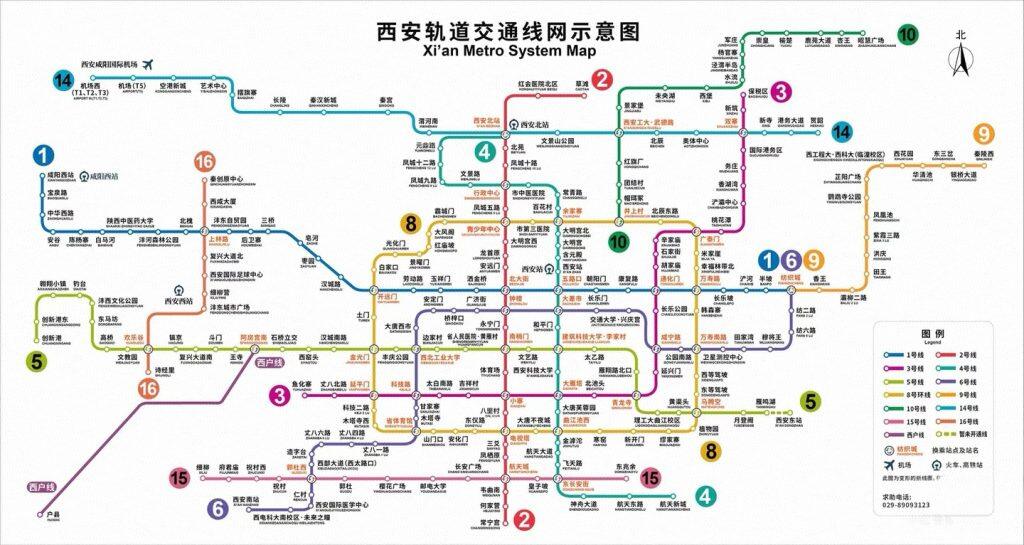
Key Metro Lines You‘ll Use on Your Xi‘an Metro Trip
You don‘t need to memorize all 12 lines — I certainly haven‘t. But there are a few absolute must-know lines that will carry you to 90% of the places you want to go. Here‘s my cheat sheet based on years of trial, error, and countless happy discoveries:
🔴 Line 1 (Red – East-West Backbone) – This line runs from Xianyang West Railway Station in the west to Fangzhicheng in the east, with 30 stations and a total length of about 42 kilometers. It‘s your ticket to the city‘s heart, passing through Beidajie (connecting to Line 2), Wulukou (a major shopping area), and Banpo (home to the famous Banpo Museum). If you‘re here for history, Line 1 is your ride.
🔵 Line 2 (Blue – The North-South Gold Line) – This is my personal favorite and honestly the most useful line for tourists. It runs from Caotan in the north to Changninggong in the south, with 25 stations and a length of 33.4 kilometers. What makes Line 2 special is that it hits almost every major tourist attraction in the city — Xi‘an North Railway Station (connecting to high-speed rail and Line 4/14), Bell Tower (the absolute heart of the city), Yongningmen (the South Gate of the City Wall), Xiaozhai (the city‘s busiest shopping district, connecting to Line 3), and Conference and Exhibition Center. A local tip: get off at Bell Tower Station, walk around the square, and just watch the ancient and modern collide — it‘s the most Xi‘an thing you can do.
🟢 Line 3 (Green – The Tourist Favorite) – This line runs from Yuhuazhai to Bonded Zone, with 26 stations and a length of 40 kilometers. It‘s your gateway to Big Wild Goose Pagoda (Dayanta Station), Shaanxi History Museum (Xiaozhai Station, transfer with Line 2), and the Muslim Quarter area. I‘ve used this line countless times to hop between Xi‘an‘s most beautiful spots, and it never disappoints.
🟠 Line 4 (Orange – The Cultural Connector) – Running north-south through the city, Line 4 connects the Qujiang scenic area and Tang Paradise to the northern parts of the city. It‘s a quieter, more relaxed line that‘s perfect for exploring Xi‘an‘s cultural side.
🟣 Line 5 (Purple – The New Star) – This line runs from Innovation Port all the way to Xi‘an East Railway Station, with 34 stations and a length of 45 kilometers. The East Extension opened on June 30, 2026, adding Yanming Lake and Xi‘an East Railway Station to the network. This is now the line you take if you‘re arriving or departing from Xi‘an‘s newest railway hub.
🟡 Line 8 (Yellow – The Loop Line) – Here‘s the game-changer for anyone navigating Xi‘an in 2026. Line 8 is China‘s first fully automated loop metro line, which opened on December 26, 2024. It connects to every major route in the city, making transfers incredibly convenient. If you‘re not sure which line to take, just hop on Line 8 and you‘ll eventually get where you need to go.
🟠 Line 9 (Orange – The Terracotta Army Line) – This is the line every tourist needs to know about. Line 9 runs directly toward the Terracotta Army Museum (though you‘ll still need a short bus or taxi from the station). It operates from 6:00 AM to 10:30 PM.
✈️ Line 14 (Light Blue – The Airport Express) – This is how you get from Xi‘an Xianyang International Airport into the city center. It connects the airport directly to Xi‘an North Railway Station, making airport transfers fast and convenient. The line runs from 6:00 AM to 10:30 PM.
🆕 Line 15 (The Southern Corridor) – This line opened in late 2025 and runs from Xiliu in the west to Dongzhaoyu in the east, with 13 stations and a length of 19.4 kilometers. It connects three major areas of Chang‘an District — the Silk Road Science City, Western University Town, and Xi‘an Aerospace City. As of January 2026, the last train from Dongzhaoyu has been extended to 23:30, making it even more convenient for late-night travelers.
How to Buy Metro Tickets in Xi‘an
Okay, let‘s talk about the practical stuff — because nothing kills the excitement of a Xi‘an metro trip faster than standing helplessly in front of a ticket machine with a long line forming behind you. I‘ve been there, and it‘s not fun. Here‘s everything you need to know.
Option 1: QR Code Scanning (My Absolute Top Pick) – This is what I use every single day and it‘s honestly life-changing. Use Alipay (search for “Xi‘an Metro Ride Code”) or WeChat to generate a metro QR code. At the gate, just scan the QR code, walk through, and scan again when you exit. The fare is automatically calculated and deducted based on your entry and exit stations. It‘s seamless, it‘s fast, and it saves you from carrying loose change or figuring out complicated fare calculations. If you‘re visiting from overseas, Alipay now allows you to link international credit cards, which makes the whole process incredibly smooth. It takes a few minutes to set up, but it‘s absolutely worth it for the convenience.
Option 2: Chang‘an Tong Card (Transportation Card) – This is Xi‘an‘s official transportation card, and it works on buses and metro. You can buy one at any metro station for a 20 RMB deposit, then top it up with credit. The real perk? 10% discount on every ride. If you‘re staying for a week or more, this card is incredibly convenient, especially as a backup when your phone battery dies (which, let‘s be honest, always happens at the worst possible moment).
Option 3: Single-Journey Tokens – These are the plastic tokens you get from ticket vending machines. They work fine for one-off rides, but I honestly don‘t recommend them for tourists. Why? Because you need exact change or small bills, the machines can be confusing if you don‘t read Chinese, and you have to queue twice — once to buy, once to exit. It‘s doable, but it‘s the least convenient option.
Option 4: Tourist Day Passes – Xi‘an offers 1-Day Pass (15 RMB) and 3-Day Pass (40 RMB) that give you unlimited rides within 24 or 72 hours after first use. If you‘re planning a sightseeing marathon, these are fantastic value. And here‘s the best part — you don‘t have to return them, so you can keep them as a souvenir.
Option 5: Prepaid Metro Pass – You can also buy a pass with 50 RMB value for 38 RMB or 100 RMB value for 68 RMB, valid for one year from first use.
Pro tip from painful experience: Always carry a backup payment method. I‘ve had my phone battery die mid-trip more times than I‘d like to admit, and having a Chang‘an Tong card in my wallet saved me every single time. Also, make sure you use the same app or card for both entry and exit — mixing different methods will cause problems at the gate.
Important Tips for a Smooth Xi‘an Metro Trip
After hundreds of metro rides across Xi‘an, I‘ve compiled a list of lessons learned the hard way — so you don‘t have to.
🕐 Rush Hour Is Real – Plan Accordingly – Line 2 between 8:00-9:00 AM and 6:00-7:00 PM is genuinely one of the most crowded train experiences you‘ll ever have. I‘m talking shoulder-to-shoulder, personal-space-is-a-memory packed. Bell Tower Station and Xiaozhai Station are particularly brutal during these times. If you‘re traveling with luggage, small children, or just value your personal space, avoid these times at all costs.
🏛️ Tourist Attraction Access – Most of Xi‘an‘s major attractions are metro-accessible, but not all. The Terracotta Army requires taking Line 9 and then a short bus or taxi. Mount Hua and Qianling Mausoleum require separate transport. Plan accordingly.
🧳 Luggage Etiquette – If you‘re carrying large suitcases, use the elevators, not the escalators. I‘ve watched too many tourists struggle with rolling luggage on moving stairs, and it‘s both dangerous and stressful. Every station has accessible elevators — just look for the signs.
⏱️ Don‘t Overstay – You have a maximum time limit from entry to exit. It sounds like plenty of time, but if you‘re doing a long day of sightseeing with multiple transfers, it can sneak up on you. Keep an eye on the clock.
🚻 Bathroom Locations – Need to find a restroom in a hurry? The Xi‘an Metro app has a station facility finder that shows you exactly where the bathrooms are. This has saved me more times than I care to count — especially after a big bowl of yangrou paomo (lamb stew with bread).
📱 Stay Connected – Free Wi-Fi is available on most trains and in stations, but it can be spotty. I recommend getting a local SIM card or an eSIM before you arrive so you‘re never stranded without navigation. Baidu Maps and Amap are more accurate for metro routes in China than Google Maps.
💬 Language – Station announcements are in Mandarin and English. Signs are bilingual too. When in doubt, just show your destination station name (in Chinese characters) to a staff member — they‘re universally helpful and used to assisting tourists.
🍜 Food Etiquette – Please, for the love of everything good, don‘t eat or drink on the train. Nobody wants to smell your spicy noodles in a crowded carriage. Save the snacking for when you get off — and trust me, there‘s always an incredible restaurant waiting for you right outside the station.
📞 Emergency Contact – If you encounter any issues, you can call the Xi‘an Metro passenger service hotline at 965916. They handle inquiries, suggestions, lost and found, and emergencies.
FAQ – Your Xi‘an Metro Trip Questions
Q: What‘s the absolute best way to pay for the metro as a tourist in 2026?
A: Without a doubt, use the QR code feature in Alipay (search for “Xi‘an Metro Ride Code”). This is what I‘ve been using for years, and it‘s honestly the most stress-free option. You don‘t need to worry about buying tickets, calculating fares, or carrying exact change — just scan your phone at the gate and go. The fare is automatically calculated and deducted when you scan out. Xi‘an has gone almost completely cashless at this point — even the ticket machines are gradually being phased out in favor of QR scanners. If you‘re visiting from overseas, Alipay now allows you to link international credit cards, which makes the whole process incredibly smooth. If you‘re worried about your phone battery (and trust me, I‘ve been there), get a Chang‘an Tong transportation card as a backup — they work on buses too and give you a 10% discount on every ride. One thing to note: the QR code system is “one person, one code” — you can‘t scan for multiple people with one phone. If you‘re traveling with family or friends, everyone needs their own code or card. It takes a few minutes to set up, but it‘s absolutely worth it for the convenience. And if you‘re planning a full day of sightseeing, the 1-Day Pass (15 RMB) or 3-Day Pass (40 RMB) are incredible value — you can ride unlimited times and keep the card as a souvenir.
Q: How do I get from Xi‘an Xianyang International Airport to the city center using the metro?
A: This is one of the most common questions I get, and the answer is refreshingly simple: take Metro Line 14 directly from the airport into the city. The airport has a dedicated metro station integrated right into the terminals — just follow the signs for “Metro” after you collect your luggage. The line connects the airport directly to Xi‘an North Railway Station, where you can transfer to Lines 2 and 4. Trains run from 6:00 AM to 10:30 PM. I‘ve made this trip dozens of times and never once regretted choosing the train over a taxi. The taxi ride from the airport can take anywhere from 45 minutes to over an hour depending on traffic, and it‘ll cost you at least 10 times more. The metro is faster, cheaper, and more reliable. One thing to keep in mind: if you‘re arriving late at night, check the last train time — Line 14‘s last train from the airport usually departs around 10:30 PM. If you miss it, you‘ll have to take a taxi or wait for the night bus.
Q: Is the Xi‘an Metro easy to navigate for someone who doesn‘t speak Chinese?
A: Yes — and I say this as someone who arrived in Xi‘an with exactly zero Mandarin skills. All stations have bilingual signs in Chinese and English, and train announcements are made in Mandarin and English. The metro map is color-coded and intuitive, and the official app has an English interface. That said, I‘ll give you one piece of honest advice: download a metro map app before you arrive and save it offline. Some of the older stations have less consistent English signage, and having a backup map on your phone gives you total peace of mind. Also, don‘t be shy about asking staff for help — they‘re used to assisting tourists and many speak basic English. I‘ve had station staff walk me to the right platform more than once, and they were always patient and kind. One thing I‘ve learned: if you‘re really stuck, just show the staff the Chinese characters for your destination station on your phone — they‘ll point you in the right direction immediately. And if all else fails, the station maps are color-coded, so you can always find your way by matching colors. One more tip: download Baidu Maps or Amap for more accurate metro routing — they work better in China than Google Maps.
Q: What are the must-see attractions that are easily accessible by metro?
A: Oh, this is my favorite question because Xi‘an‘s metro literally takes you everywhere worth going in the city center. Here are my absolute must-visits: Bell Tower & Drum Tower – take Line 2 to Bell Tower Station, the absolute heart of the city. City Wall (South Gate) – take Line 2 to Yongningmen Station and walk up onto the ancient wall. Big Wild Goose Pagoda – take Line 3 to Dayanta Station. Shaanxi History Museum – take Line 2 or Line 3 to Xiaozhai Station. Muslim Quarter – take Line 2 to Bell Tower Station and walk west. Daming Palace – take Line 4 to Daming Palace West Station. Terracotta Army – take Line 9 toward the museum area (then a short bus or taxi). And here‘s a local secret: instead of just hitting the tourist traps, take Line 4 to the Qujiang area and explore the Tang Paradise and the surrounding scenic areas. Or take Line 2 to Xiaozhai and just wander through the shopping district — it‘s the busiest commercial area in Xi‘an and gives you a real feel for modern city life. The beauty of the Xi‘an Metro is that every station opens up a new neighborhood to explore, and some of the best experiences are the ones you stumble upon by accident. Just pick a line, get off at a random station, and start walking — you‘ll discover something amazing, I promise.

Dalia Xu
Dalia Xu is a 30-year-old female seasoned travel enthusiast
with over a decade of travel experience,
she has a passion for natural landscapes and hotel reviews.
Essential Metro Map Guide
Your Ultimate Guide to the Shanghai Metro Map
Your Ultimate Guide to the Beijing Metro Map
Your Perfect Guide to the Guangzhou Metro Map
Chengdu Metro Trip Guide: Easy Navigation
Essential Shenzhen Metro Trip Guide
Hangzhou Metro Travel Guide: Top Tips
Chongqing Metro Guide: Smooth Trip Tips
Xiamen Metro Trip Guide: Easy to Navigate
Essential Kunming Metro Trip Guide for Visitors
Nanjing Metro Travel Guide: Top Practical Tips
Qingdao Metro Guide: Must-Know Trip Tips
Harbin Metro Travel Guide for a Perfect Trip
Zhengzhou Metro Guide: Essential Trip Tips
Changsha Metro Travel Guide: Smooth Journey Tips
Popular City Travel Guides
Beijing Travel Guide Shanghai Travel Guide Hangzhou Travel Guide Sanya Travel Guide Chongqing Travel Guide
Nanjing Travel Guide Guangzhou Travel Guide ChengduTravel Guide Hongkong Travel Guide Xi’an Travel Guide